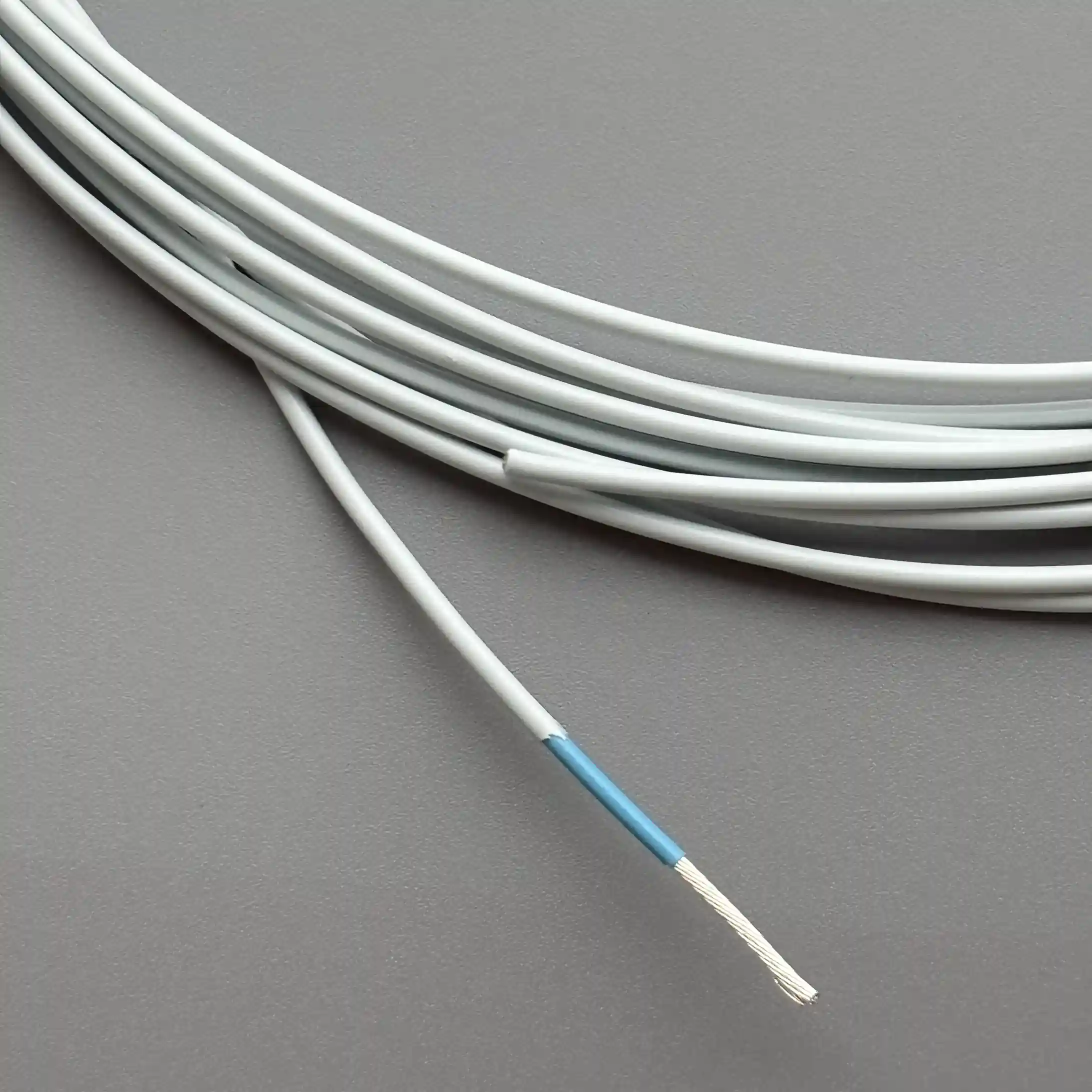
MIL-SPEC wire is electrical wire manufactured to the requirements of a specific military specification or an applicable military-adopted industry standard. Those requirements define characteristics such as conductor construction, insulation, dimensions, electrical performance, testing, and identification.
The term describes a broad category. To identify an actual wire, you need the governing specification, its detail specification or “slash sheet,” and the complete part number.
For example, SAE AS22759 covers fluoropolymer-insulated, single-conductor wires with coated copper or copper-alloy conductors. Different detail specifications within that family define different constructions and ratings. Simply requesting “MIL-SPEC wire” leaves those essential details unresolved. SAE AS22759<!– IMAGE 1: Insert after “Simply requesting “MIL-SPEC wire” leaves those essential details unresolved.” | Visual: Original annotated cutaway showing a stranded conductor, conductor coating, and insulation, alongside a separate shielded multicore cable to distinguish primary wire from cable | Alt: “Construction of an insulated primary wire and a shielded multicore cable” | Source: original diagram –>
What Does “MIL-SPEC” Actually Tell You?
A specification gives manufacturers and buyers a defined set of requirements against which a product can be evaluated. It helps engineers specify a repeatable construction and procurement teams identify the required product.
However, the words “MIL-SPEC” alone do not establish:
- A particular temperature or voltage rating.
- A specific insulation material.
- Shielding or electromagnetic interference protection.
- Suitability for every aircraft, military platform, or installation.
- Qualification of a particular manufacturer or product.
The distinction between meeting technical requirements and holding a required product qualification matters. Where qualification applies, buyers must verify the relevant product and manufacturing source against the applicable qualification records. DLA identifies the Qualified Products Database, or QPD, as the official source for Department of Defense qualification data. DLA qualification guidance
Common MIL-SPEC Wire and Cable Standards
Several specification families appear regularly in aerospace and defense wiring discussions. Their scopes differ.
| Specification family | What it covers | What to check |
|---|---|---|
| SAE AS22759, often associated with legacy MIL-W-22759 references | Fluoropolymer-insulated, single-conductor copper or copper-alloy wire | Exact slash sheet, conductor coating, insulation construction, dimensions, and ratings |
| SAE AS81044 | Single-conductor wires using specified crosslinked insulation systems | Applicable detail sheet and complete insulation construction |
| MIL-DTL-16878 | Unshielded hookup and lead wire for electrical and electronic equipment | Exact detail specification and document status, particularly for new designs |
| ANSI/NEMA WC 27500, replacing MIL-DTL-27500 | Aerospace and industrial electrical cable, including shielded and unshielded constructions | Component wires, conductor count, shielding, jacket, and finished-cable requirements |
These scopes are defined by the respective standards. The DLA record currently lists MIL-DTL-16878 as inactive; a legacy specification reference should therefore be checked before it is carried into a new design. SAE AS81044, DLA MIL-DTL-16878 record, NEMA WC 27500 scope
Why Do SAE Standards Still Appear in MIL-SPEC Wire Searches?
Many established military wire designations remain familiar after the governing documents have moved to industry standards.
For example, the Department of Defense adoption notice for SAE AS22759/16 directs users to that standard in place of the canceled MIL-W-22759/16A. Procurement documents and product markings can still contain familiar M22759 references, so engineers must distinguish the part designation from the governing document. DoD adoption notice for AS22759/16
What Is MIL-SPEC Wire Made Of?
The construction depends on the applicable specification. Three elements are particularly important when comparing installation wires.
Conductor and Coating
The conductor carries current. Its material, cross-sectional area, and strand construction affect resistance, mechanical behavior, and termination requirements.
AS22759 includes copper and copper-alloy conductors with tin, silver, or nickel coatings, as specified by the detail sheet. These coatings form part of the defined construction; they should not be substituted solely because two wires have the same AWG size.
Insulation
The insulation electrically separates the conductor from surrounding conductors and equipment. AS22759 permits several fluoropolymer systems, including PTFE, FEP, and ETFE, used alone or in specified combinations with other materials. The applicable detail specification determines the actual construction. AS22759 material scope
For buyers comparing PTFE installation wire with crosslinked ETFE installation wire, the polymer name is only the starting point. Insulation thickness, layer arrangement, conductor coating, finished diameter, and verified test performance also matter.
A material’s temperature capability does not automatically establish the continuous operating temperature of the finished wire. Likewise, a short-duration heat test does not establish a continuous service rating.
Shield and Jacket
A basic insulated wire may have neither a shield nor an overall jacket. When wires are combined into a cable, additional layers can provide functions such as electromagnetic shielding and mechanical protection.
The finished cable must be evaluated as a complete construction. NEMA WC 27500 addresses component wires, shields, jackets, functional requirements, identification, and qualification. Selecting an appropriate primary wire is one part of specifying the complete cable. NEMA cable construction requirements
Do All MIL-SPEC Wires Have the Same Ratings?
No. Even wires within AS22759 can differ substantially.
| Detail specification | Insulation | Conductor coating | Listed temperature rating | Listed voltage rating |
|---|---|---|---|---|
| AS22759/11 | PTFE | Silver | 200°C | 600 V |
| AS22759/12 | PTFE | Nickel | 260°C | 600 V |
| AS22759/16 | Extruded ETFE | Tin | 150°C | 600 V |
| AS22759/32 | Crosslinked ETFE | Tin | 150°C | 600 V |
| AS22759/44 | Crosslinked ETFE | Silver | 200°C | 600 V |
These examples show why the slash sheet matters: a shared specification family or insulation category does not guarantee matching ratings. NASA AS22759 detail-specification reference
A voltage rating also does not give the allowable current. Current-carrying capability requires a separate assessment of conductor size, ambient temperature, bundling, installation conditions, and allowable temperature rise.<!– IMAGE 2: Insert after “Current-carrying capability requires a separate assessment of conductor size, ambient temperature, bundling, installation conditions, and allowable temperature rise.” | Visual: Comparison diagram of PTFE, extruded ETFE, and crosslinked ETFE wire constructions with labels directing readers to the applicable slash sheet for ratings; avoid depicting all constructions with identical insulation thickness | Alt: “Wire insulation comparison showing why material alone does not determine electrical and temperature ratings” | Source: original diagram –>
How to Read a MIL-SPEC Wire Part Number
Consider NASA’s example:
M22759/11-22-90
| Part-number element | Meaning |
|---|---|
| M22759 | Specification-family designation |
| /11 | Detail specification defining the wire construction |
| -22 | Conductor size: 22 AWG |
| -90 | Color-code designation |
NASA identifies the final field as a color code in accordance with MIL-STD-681. The detail specification supplies the construction requirements that the short part number cannot explain on its own. NASA part-number explanation
For purchasing, preserve the complete designation. Omitting the slash sheet can remove information that distinguishes insulation systems, conductor coatings, and ratings.
Is Aerospace Installation Wire Automatically MIL-SPEC?
An aerospace application, a high temperature rating, or a familiar insulation material does not by itself establish compliance with a particular military specification.
This matters when comparing product families such as YHAX and C55 crosslinked-ETFE constructions with AF-250 and AFR250 PTFE installation wires. These are useful starting points for discussing construction and installation requirements. Establishing interchangeability with an M22759 part requires a detailed comparison against the exact specification.
For example, two wires described as “silver-coated copper with fluoropolymer insulation” may still differ in:
- Strand count and individual strand diameter.
- Insulation material, processing, and wall thickness.
- Finished diameter and dimensional tolerances.
- Electrical resistance and insulation performance.
- Environmental test requirements.
- Marking, traceability, and qualification status.
A reference to one military test does not demonstrate compliance with every requirement of a wire specification. Similarly, a company’s quality management system certification does not establish that every wire it manufactures is a qualified product.
For AS22759 procurement requiring qualification, verify the applicable listing in the current QPD. DLA’s AS22759 record confirms that the former document-based qualified products list has been converted to an electronic qualification dataset. DLA AS22759 qualification record
Where Is MIL-SPEC Wire Used?
Typical applications include aircraft wiring, avionics, defense electronics, and other equipment requiring defined electrical and environmental performance. Certain qualified wire and cable constructions also serve demanding industrial applications. Military-qualified wire and cable applications
Suitability still depends on the installation. A wire appropriate for protected equipment wiring may need additional protection where routing exposes it to abrasion, repeated movement, fluids, or mechanical damage.
For shielded signal wiring, specify the complete cable construction and shielding requirements. For space or vacuum service, identify the project’s additional material and verification requirements rather than assuming that a general MIL-SPEC designation covers them.
What Should You Specify When Requesting MIL-SPEC Wire?
A useful inquiry begins with the required part number or drawing. If the construction has not yet been selected, provide:
- Governing standard and detail sheet, including the required revision or contractual baseline.
- Conductor size, material, coating, and stranding.
- Operating voltage, current, and temperature conditions.
- Installation conditions, including bundling, movement, fluid exposure, and routing constraints.
- Dimensional limits, particularly finished diameter and connector compatibility.
- Shielding and jacket requirements, where a cable is needed.
- Required evidence, such as qualification records, conformity documentation, test reports, and batch traceability.
When considering an alternative construction, compare it against the original drawing and specification before approving the substitution. Matching AWG, voltage, and temperature is a useful first check, but it does not establish complete equivalence.
For an installation-wire inquiry, send Jiangsu Yuhang your required standard or existing part number, conductor size, operating conditions, and documentation requirements. Identify whether the project requires a qualified source or allows an alternative construction subject to engineering approval, so the proposed wire can be assessed against the right requirements.